DISCLAIMER

“GED®
is a registered trademark of the American Council on Education (ACE) and
administered exclusively by GED Testing Service LLC under license. This material [or
content] is not endorsed or approved by ACE or GED Testing Service.”
Showing posts with label charles darwin. Show all posts

Monday, January 1, 2018

GED Speciation or where species come from


From YouTube


In biology, a species is the basic unit of biological classification and a taxonomic rank. A species is often defined as the largest group of organisms in which two individuals can produce fertile offspring, typically by sexual reproduction. While this definition is often adequate, when looked at more closely it is problematic. For example, with hybridisation, in a species complex of hundreds of similar microspecies, or in a ring species, the boundaries between closely related species become unclear. Other ways of defining species include similarity of DNAmorphology or ecological niche.
All species are given a two-part name, a "binomial". The first part of a binomial is the genus to which the species belongs. The second part is called the specific name or the specific epithet (in botanical nomenclature, also sometimes in zoological nomenclature). For example, Boa constrictor is one of four species of the Boa genus.
Species were seen from the time of Aristotle until the 18th century as fixed kinds that could be arranged in a hierarchy, the great chain of being. In the 19th century, biologists grasped that species could evolve given sufficient time. Charles Darwin's 1859 book The Origin of Species explained how species could arise by natural selection. Genes can sometimes be exchanged between species by horizontal gene transfer; and species may become extinct for a variety of reasons.
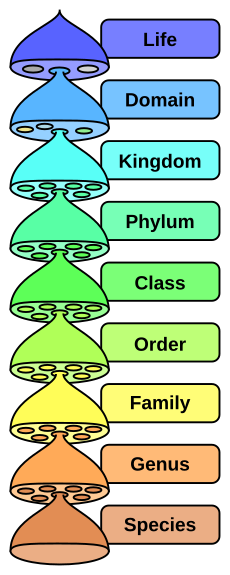
File:Biological classification L Pengo vflip.svg

Thursday, April 20, 2017

Success GED Natural Selection


Natural selection is the differential survival and reproduction of individuals due to differences in phenotype. It is a key mechanism of evolution, the change in heritable traits of a population over time. Charles Darwin popularised the term "natural selection", and compared it with artificial selection.
Variation exists within all populations of organisms. This occurs partly because random mutations arise in the genome of an individual organism, and offspring can inherit such mutations. Throughout the lives of the individuals, their genomes interact with their environments to cause variations in traits. The environment of a genome includes the molecular biology in the cell, other cells, other individuals, populations, species, as well as the abiotic environment. Individuals with certain variants of the trait may survive and reproduce more than individuals with other, less successful, variants; therefore, the population evolves. Factors that affect reproductive success are also important, including sexual selection (now often included in natural selection) and fecundity selection.
Natural selection acts on the phenotype, or the observable characteristics of an organism, but the genetic (heritable) basis of any phenotype that gives a reproductive advantage may become more common in a population. Over time, this process can result in populations that specialise for particular ecological niches (microevolution) and may eventually result in speciation (the emergence of new species, macroevolution). In other words, natural selection is a key process in the evolution of a population. Natural selection can be contrasted with artificial selection, in which humans intentionally choose specific traits, whereas in natural selection there is no intentional choice.
Natural selection is one of the cornerstones of modern biology. The concept, published by Darwin and Alfred Russel Wallace in a joint presentation of papers in 1858, was elaborated in Darwin's influential 1859 book On the Origin of Species by Means of Natural Selection, or the Preservation of Favoured Races in the Struggle for Life, which described natural selection as analogous to artificial selection, a process by which animals and plants with traits considered desirable by human breeders are systematically favoured for reproduction. The concept of natural selection originally developed in the absence of a valid theory of heredity; at the time of Darwin's writing, science had yet to develop modern theories of genetics. The union of traditional Darwinian evolution with subsequent discoveries in classical genetics formed the modern synthesis of the mid-20th century. The addition of molecular genetics has led to evolutionary developmental biology, which explains evolution at the molecular level. While genotypes can slowly change by random genetic drift, natural selection remains the primary explanation for adaptive evolution.